 07971549540
 Send Inquiry
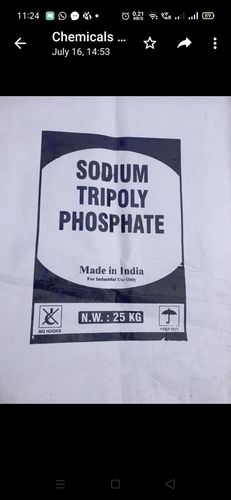
Sodium Tripolyphosphate
56 INR/Kilograms
Product Details:
- Purity 99 %
- Molecular Formula Na5P3O10
- Molecular Weight 367.864 g/mol Grams (g)
- Solubility 14.5 g/100 mL (25 C)
- Form Powder
- Chemical Name Na5P3O10
- CAS No 7758294
- Click to View more
X
Sodium Tripolyphosphate Price And Quantity
- 100 Kilograms
- 56 INR/Kilograms
Sodium Tripolyphosphate Product Specifications
- Na5P3O10
- Industrial, Water Treatment
- 99 %
- 367.864 g/mol Grams (g)
- STPP is used as a preservative for poultry, meat, and seafood. It is also added, along with other sodium polyphosphates, to processed cheeses as an emulsifier. The polyphosphates are negatively charged chains of phosphorus and oxygen that attract water molecules.
- 14.5 g/100 mL (25 C)
- Na5P3O10
- Industrial Grade
- Powder
- Phosphate
- 7758294
Sodium Tripolyphosphate Trade Information
- Cash Against Delivery (CAD)
- 50000 Kilograms Per Month
- 3 Days
- Within a certain price range free samples are available
- 25 kg
- Asia, Australia, Middle East, Africa
- All India
Product Description
Sodium triphosphate, also sodium tripolyphosphate, or tripolyphosphate, is an inorganic compound with formula Na PO. It is the sodium salt of the polyphosphate penta-anion, which is the conjugate base of triphosphoric acid.
STPP is used as a preservative for poultry, meat, and seafood. It is also added, along with other sodium polyphosphates, to processed cheeses as an emulsifier. The polyphosphates are negatively charged chains of phosphorus and oxygen that attract water molecules.
Sodium Tripolyphosphate Overview
Sodium Tripolyphosphate (STPP) is a phosphate-based compound widely utilized in industrial settings including food preservation and water treatment applications.
Chemical Properties of STPP
STPP features a purity of 99% and is soluble in water, with a solubility of 14.5 g per 100 mL at 25 degrees Celsius.
Applications of Sodium Tripolyphosphate
STPP is used as a preservative for meat products, seafood, and poultry, enhancing water retention and prolonging freshness. Its also an emulsifier in processed cheese manufacturing.
FAQs of Sodium Tripolyphosphate:
Q: What is the molecular formula of Sodium Tripolyphosphate?
A: The molecular formula of Sodium Tripolyphosphate is Na5P3O10.Q: How is STPP used in the food industry?
A: STPP is used as a preservative for poultry, meat, and seafood, as well as an emulsifier in the production of processed cheeses.Q: When was Sodium Tripolyphosphate discovered?
A: Sodium Tripolyphosphate was identified in the course of phosphate-based compound research, though specific discovery details are generally less documented in product contexts.Q: Where can Sodium Tripolyphosphate be applied?
A: STPP can be applied in food preservation, water treatment, and in industrial processes requiring a phosphate compound.Q: What is the solubility of Sodium Tripolyphosphate in water?
A: Sodium Tripolyphosphate has a solubility of 14.5 g/100 mL at 25 C.Q: How does Sodium Tripolyphosphate benefit food preservation?
A: STPP helps preserve food by attracting water molecules, leading to improved water retention, freshness, and texture in poultry, meat, and seafood.Q: Why is STPP an effective preservative?
A: The effectiveness of STPP as a preservative is due to its phosphate composition, which can control moisture content and prevent spoilage effectively.Tell us about your requirement

Price:
Quantity
Select Unit
- 50
- 100
- 200
- 250
- 500
- 1000+
Additional detail
Mobile number
Email

Other Products in 'Industrial Chemical Supplies' category



Contact Us

- Ground Floor, Block No. 351, P2, Tundev, Namisara Road, Savli,Vadodara - 390019, Gujarat, India
- Phone : 07971549540
DHAIRYA INTERNATIONAL
GST : 24AVTPR8967R1ZZ
GST : 24AVTPR8967R1ZZ

- Mr Dhairya Kumar (MD)
- Mobile :07971549540
- Ms. Khushi (Production Manager)
- Mobile :07971549540
- sales@kadarachemicalsindia.com
- Mobile :+918320159980, +918035063440

|


DHAIRYA INTERNATIONAL
All Rights Reserved.(Terms of Use)
Developed and Managed by Infocom Network Private Limited.
Developed and Managed by Infocom Network Private Limited.

